The Physics Behind Plinko Boards Understanding the Chaos and Chance

The Physics Behind Plinko Boards: Understanding the Chaos and Chance
Plinko boards have captivated audiences for decades, famously featured on television shows like «The Price is Right.» This engaging game consists of a vertical board with pegs arranged in a grid pattern, where a disc is dropped from the top, bouncing off pegs and eventually landing in one of several slots at the bottom, each representing different prizes. But what lies behind the seemingly random and chaotic nature of Plinko? In this article, we will unravel the physics behind the Plinko board and shed light on the interplay of gravity, motion, and chance. For more information about Plinko, visit Plinko Board Physics Behind The Scenes plinko-casino-game.co.nz.
The Components of a Plinko Board
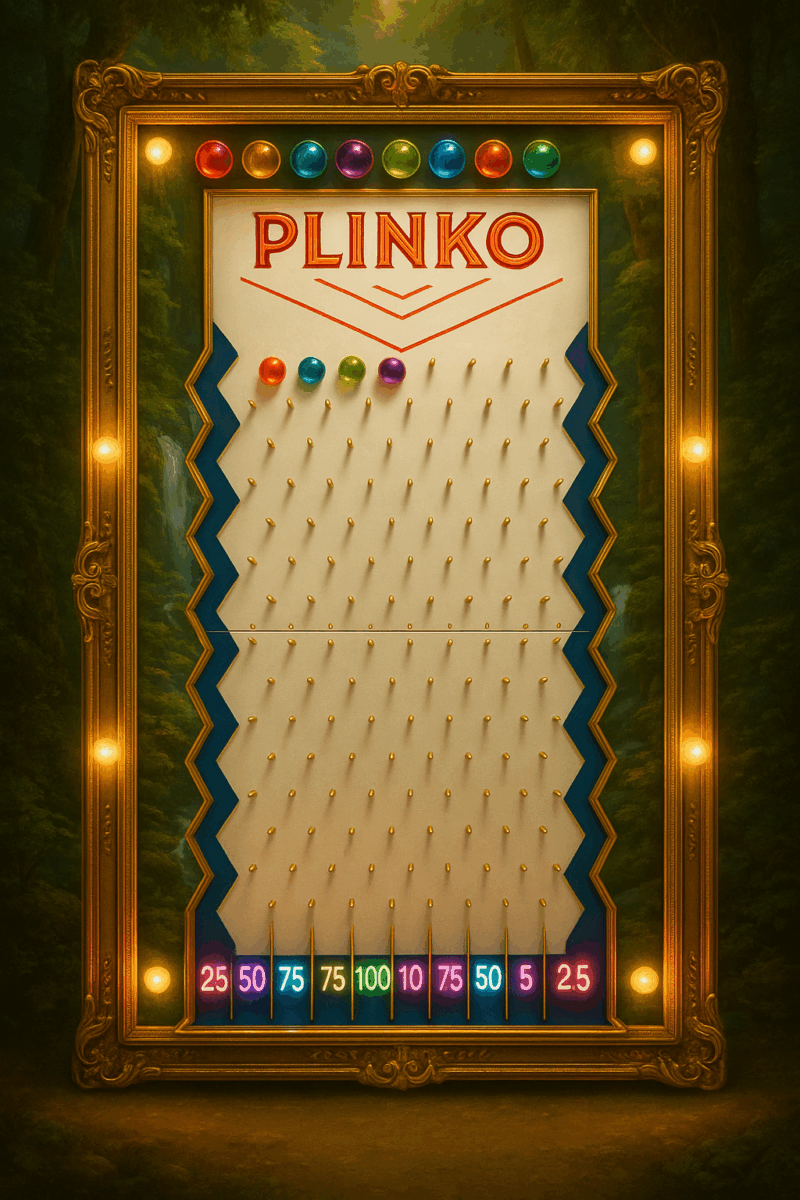
To understand the physics at play, we first need to examine the components of a Plinko board. The main elements include:
- The Board: The vertical surface that holds the pegs and slots.
- The Pegs: Small protrusions that disrupt the path of the falling disc and create unpredictable trajectories.
- The Slots: The various endpoints at the bottom of the board, each associated with a different prize or score.
- The Discs: The items dropped from the top of the board, typically circular and made of a lightweight material.
How Gravity Influences Plinko
Gravity is perhaps the most critical force in the Plinko experience. When a disc is dropped from the top of the board, it accelerates downward due to gravitational pull. The acceleration caused by gravity is approximately 9.81 m/s² on Earth. As the disc falls, it gains speed, which increases its kinetic energy.
Additionally, gravity plays a significant role in how the disc interacts with the pegs. As the disc descends, it will inevitably collide with pegs, causing it to bounce off in a direction that is not linear. This bouncing is where the unpredictability of the game emerges.
The Role of Collisions
The interactions between the disc and pegs can be analyzed using the principles of physics, specifically the laws of motion and momentum. When the disc hits a peg, a collision occurs. There are two types of collisions to consider:
- Elastic Collisions: In these collisions, kinetic energy and momentum are conserved. The disc may bounce off the peg with little to no energy loss, maintaining its overall speed.
- Inelastic Collisions: In these cases, some energy is lost in the collision, and the disc experiences a change in speed after bouncing away from the peg.
The nature of these collisions ultimately determines the path the disc takes after bouncing off a peg, contributing to the randomness of the final outcome.
The Chaos Theory and Randomness
Plinko embodies principles related to chaos theory, which studies how small changes in initial conditions can lead to vastly different outcomes. This is evident in how slight variations in the angle or speed from which the disc is dropped can result in the disc landing in completely different slots. One grain of uncertainty can lead to multiple paths and outcomes, illustrating the principle of deterministic chaos.
Calculating Probabilities
While Plinko’s outcome may appear random, it can actually be analyzed mathematically with probabilities. The path of each disc can be modeled by evaluating the possible interactions with the pegs. For example, if a disc drops straight down in the center, it’s likely to hit pegs evenly distributed on either side, leading to a more central outcome. Conversely, if it falls off-center, it might favor one side more.
Using computer simulations and statistical methods, one can predict the proportions of outcomes based on initial drop points. Advanced algorithms often model such games to provide insights into the underlying probabilities quite effectively.
Design Considerations
The physical design of a Plinko board is crucial in defining how the game operates. Factors such as the height of the board, spacing of the pegs, and angle of the slots all have significant impacts on the gameplay. Designers often strive for a balance between randomness and player strategy, allowing for enjoyment while still maintaining a sense of predictability.
Real-World Applications of Plinko Physics
Understanding the physics behind Plinko has practical applications beyond entertainment. Concepts related to randomness and probability can be applied to various fields such as:
- Game Theory: Game designers use principles of probability to create fair and engaging experiences.
- Engineering: The study of collisions informs design strategies for safety features in vehicles and machinery.
- Finance: Analysts utilize probabilistic models to predict market behavior and assess risks.
Conclusion
The Plinko board is a delightful intersection of fun and physics. At first glance, it may seem like a simple game of chance, but there is a complex interplay of forces, collision dynamics, and chaos theory that governs its outcomes. By breaking down the mechanics behind the game, we gain a deeper appreciation for the underlying principles that govern so many aspects of our world. The next time you play Plinko, remember that beneath the colorful pegs and thrilling drops, a fascinating world of physics is at play.